AI team collaboration embeds AI systems directly into team workflows so leaders can automate coordination, surface better insights, and protect human judgment.
What AI team collaboration means
AI team collaboration is the practice of embedding AI systems directly into team workflows to automate coordination, surface insights, and augment human judgment across functions.
For leaders, the benefit is not only faster work. It is a clearer operating model where AI handles repeatable coordination and information retrieval while people stay responsible for strategy, judgment, relationships, and final decisions.
Teams that integrate AI into real workflows can save meaningful time on routine tasks and move through decision cycles faster because information is less scattered and follow-up becomes easier to track.
Automated task coordination frees strategic thinking time
The biggest productivity drain is often not the hard work itself. It is the coordination around the work: scheduling, meeting prep, status updates, reminders, and follow-up messages.
AI collaboration tools can draft agendas, summarize prior context, suggest next steps, and keep recurring work moving. That gives leaders and team members more time for decisions that require actual judgment.
Audit recurring work for one week and mark every predictable coordination task.
Start with scheduling, status summaries, meeting prep, or follow-up tracking.
Keep a human owner attached to each automated workflow.
Measure time saved before expanding automation to more complex work.
Faster decisions through AI-surfaced data
Decisions slow down when the right information is buried in the wrong place. AI collaboration improves decision speed by pulling relevant context, flagging contradictions, and presenting options before a leader has to chase updates manually.
The leadership bottleneck then shifts from information gathering to judgment. That is where people create the most value: choosing priorities, handling tradeoffs, and deciding what the team should do next.

Communication assistants reduce friction
Poor communication creates rework, missed expectations, and unnecessary tension. AI communication assistants can improve clarity by summarizing threads, adjusting tone, and helping teams understand context without interrupting one another.
The deeper value is consistency. When written communication becomes clearer across the team, hybrid and distributed workers spend less time decoding messages and more time acting on them.
Use AI summaries for long threads and missed meetings.
Send action items automatically after important calls.
Use tone and clarity checks for high-stakes messages.
Keep final accountability with the human sender.
Knowledge management without hoarding
Organizations lose knowledge when work lives only in private chats, personal notes, or the memory of one team member. AI-powered knowledge systems reduce that risk by tagging, linking, and surfacing useful documents at the moment people need them.
When AI handles retrieval, people can spend less time searching and more time applying what they find. Onboarding gets faster, duplicate work drops, and expertise becomes more shareable.
Remote and hybrid teams get stronger follow-up
Remote and hybrid teams carry a coordination tax. Time zones, async gaps, and meeting overload create friction that can quietly weaken execution.
AI meeting assistants, smart scheduling, and message prioritization help reduce that load. The most useful pattern is simple: capture the meeting, extract decisions and owners, send the summary quickly, and keep the resulting tasks visible.
Auto-send meeting summaries to absent teammates.
Extract owners and due dates from calls.
Prioritize messages that need action instead of simply showing everything.
Protect focus blocks across time zones.
Workflow redesign is what makes AI collaboration scale
Adding AI tools to broken workflows produces limited gains. Leaders get more value when they redesign work around the fact that AI can now own certain information-transfer steps.
A useful redesign starts by mapping workflows with multiple handoffs. Then the team separates information transfer from judgment calls. AI can support or own the repeatable transfer steps, while people focus on the decisions where accountability matters.
Map workflows with more than three handoffs.
Identify which handoffs are information transfer and which are judgment calls.
Assign AI support to predictable information-transfer steps.
Redesign the remaining process around human judgment.
Measure cycle time before and after the change.

Leadership ownership determines adoption speed
AI adoption spreads faster when leaders visibly use the tools in real decision-making. That does not mean executives need to become AI experts. It means they show that AI is part of serious work, not a side experiment.
A leader who references an AI-generated market summary, asks the team to challenge it, and then makes the final judgment models the right behavior: useful AI input with human accountability.
AI control towers prevent duplicate work
Many organizations do not lack AI tools. They lack coordination between AI tools. Different teams buy overlapping subscriptions, run similar pilots, and generate insights that never reach the people who need them.
A control tower approach gives one group responsibility for the AI roadmap, deployed tools, reusable assets, and outcome measurement. The goal is not bureaucracy. The goal is fewer duplicate efforts and faster reuse of what already works.
Human accountability has to stay primary
The underreported risk in AI collaboration is the erosion of judgment. AI outputs can sound confident even when they are incomplete or wrong, so teams need a habit of verification.
The best leaders use AI as a structured sparring partner. Ask it to argue the opposite view, surface likely failure modes, and identify missing data. That stress-tests thinking instead of replacing it.
Assign a human owner to every AI-generated recommendation.
Ask for sources, confidence levels, and missing data.
Review important decisions where AI input was significant.
Train teams to separate AI analysis from final conclusions.
Upskilling and culture change are the real cost
Technology adoption can be fast, but culture change is slower. Teams need fluency: what AI can do, where it fails, how to verify it, and when to stop and use human judgment.
That fluency develops through repeated use, visible leadership modeling, and honest reviews when AI gets something wrong. It does not come from one training session.
Key takeaways
The benefits of AI team collaboration scale when AI is embedded into workflows, leaders model responsible use, and teams keep human accountability over AI-generated outputs.
Routine coordination is the first place to automate.
Decision speed improves when AI surfaces relevant context quickly.
Communication assistants reduce friction when humans remain accountable.
Workflow redesign produces stronger gains than isolated tool pilots.
Central AI oversight prevents duplicate tools and scattered experiments.
Human judgment must stay primary for meaningful decisions.
How MoodLens puts an AI workforce behind your team
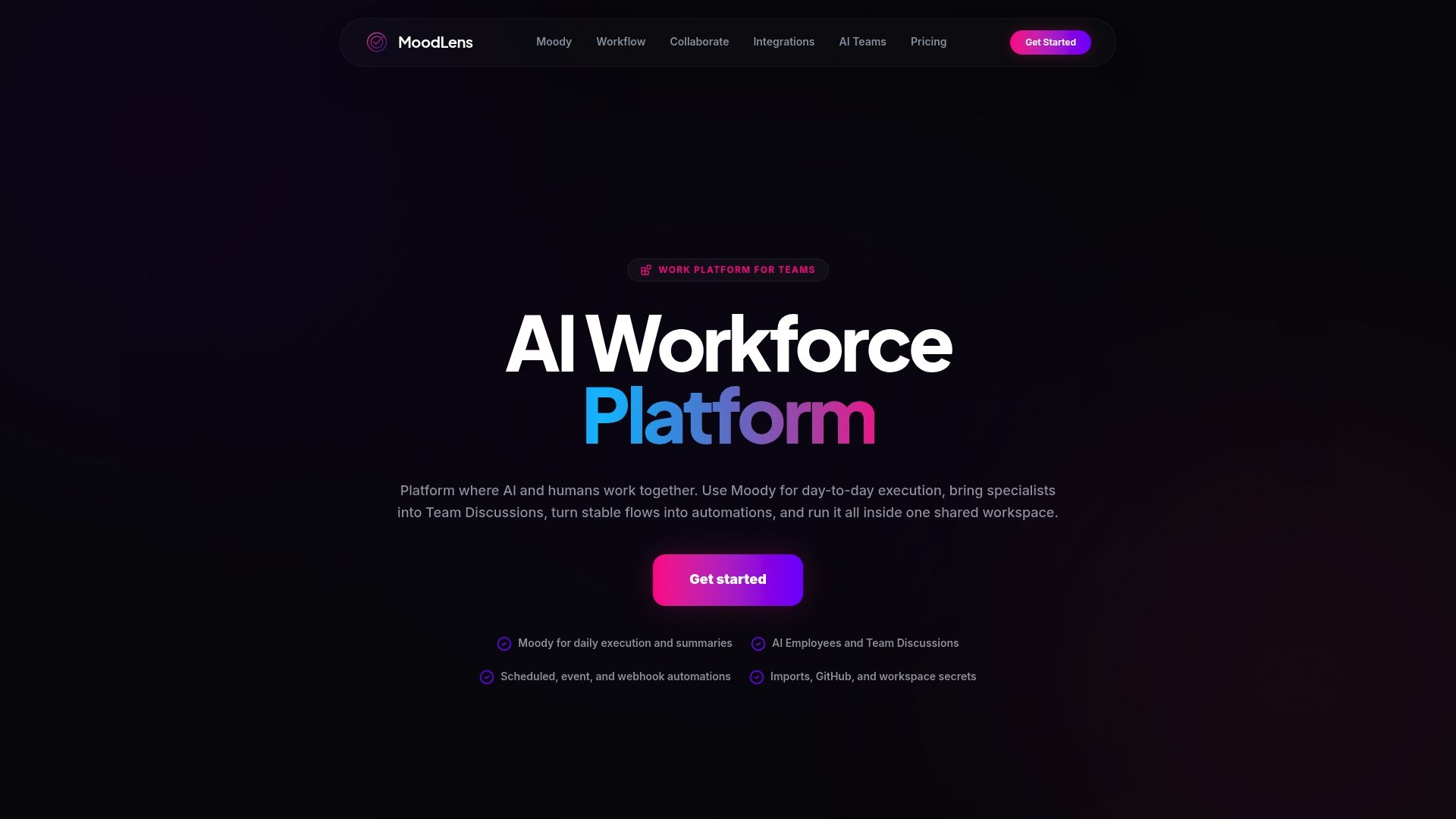
MoodLens is the solution for leaders who want AI collaboration to become part of the operating system, not another disconnected tool. It brings tasks, boards, docs, meetings, AI Employees, Team Discussions, automations, and follow-up into one shared workspace.
Instead of asking people to manually keep every board, report, and discussion updated, MoodLens helps teams coordinate AI-assisted execution around real work. Leaders can ask strategic questions, involve specialist AI Employees, keep decisions visible, and connect follow-up back to tasks and projects.
For teams that want the benefits of AI collaboration without building their own AI operating layer from scratch, MoodLens is a direct path to clearer execution and better alignment.
FAQ
What are the main benefits of AI team collaboration? The main benefits are time savings on routine work, faster decision cycles, clearer communication, better knowledge access, and stronger follow-up across teams.
How does AI improve collaboration for remote teams? AI can summarize meetings, extract action items, prioritize messages, and reduce the coordination overhead that remote and hybrid teams face.
What organizational changes are needed for AI collaboration to work? Leaders need workflow redesign, visible ownership, centralized AI oversight, and continuous upskilling rather than isolated tool pilots.
Can AI replace human judgment in team decisions? No. AI should surface options, gaps, and risks, but people remain accountable for final decisions.
What is the fastest way to start benefiting from AI team collaboration? Audit recurring coordination tasks, pick one predictable workflow, assign AI support, and measure the result before expanding.
Bring AI workflow automation into one workspace
Use MoodLens to connect AI execution, project planning, team alignment, and operational follow-up in one shared system.
Try MoodLens free → moodlenstodo.info